The best pot for your Pothos is whatever suits your watering habits.
I cannot stress that enough.
If you overwater, go terracotta and keep it snug.
If you forget to water, go plastic or ceramic and give yourself a little more wiggle room.
The only non-negotiable is drainage holes.
Does the type of pot actually matter for Pothos?
Yes, but probably not in the way you’re expecting.
The pot material affects how quickly the soil dries out, which directly affects how often you need to water.
Get the material wrong for your habits and you’re fighting against yourself every single time.
The shape and size matter too, but the most important thing is that the pot has drainage holes. More on that shortly.
Terracotta pots for Pothos
Terracotta is porous, which means it actively wicks moisture out of the soil through the pot walls.
The water soaks into the clay and then evaporates from the outside, which means your soil dries out faster than it would in plastic or ceramic.
That sounds like a downside, but for a many people, it’s exactly what they need.
Terracotta is a good choice if you:
- Tend to water too often
- Feel compelled to water on a schedule rather than based on what the plant actually needs
- Live somewhere humid, where soil takes longer to dry out anyway
- Are using a potting mix that retains moisture well
Terracotta is a bad choice if you:
- Travel frequently or are generally a “set it and forget it” plant owner
- Tend to underwater rather than overwater
- Are using a chunky, fast-draining mix that dries out quickly anyway
Terracotta is also cheap, looks good, and will outlast you. As far as plant pots go, it’s a solid option.
Plastic pots for Pothos
Plastic pots are non-porous, so the only moisture loss is through the drainage holes and the soil surface.
This means the soil stays wet for longer, which is useful if you tend to forget about your plants.
They’re also lightweight, inexpensive, and available in every size imaginable.
The humble plastic nursery pot — the kind your Pothos comes home from the garden centre in — is actually a perfectly good long-term home for your plant.
It’s not glamorous, but your Pothos doesn’t care about glamour.
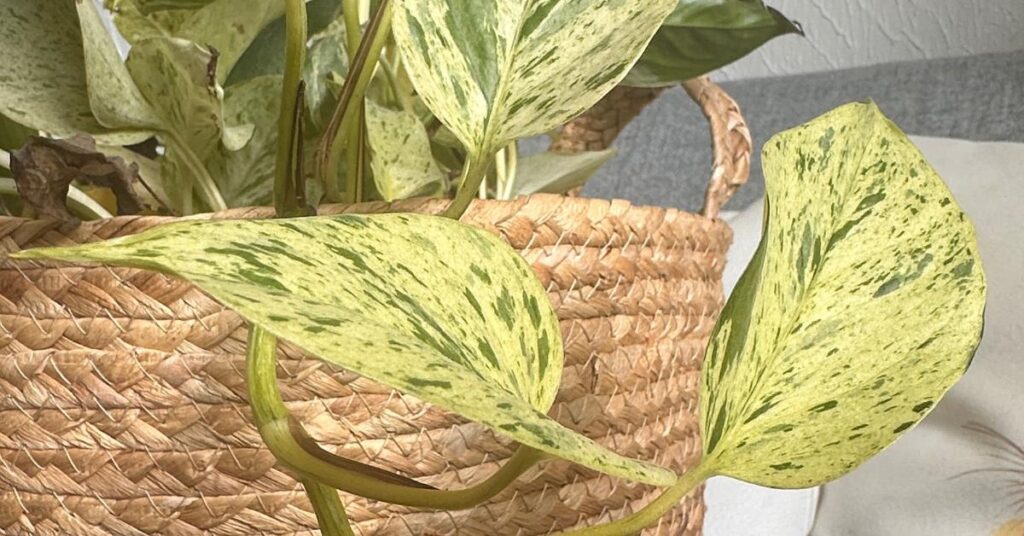
My personal approach: I use plastic nursery pots for the plants themselves and put them inside a nicer pot (called a cachepot) for display. Best of both worlds — practical watering, decent aesthetics. You just need to make sure you empty the cachepot after watering so the plant isn’t sitting in a puddle.
Plastic is a good choice if you:
- Tend to underwater or forget to water
- Are using a chunky, very free-draining mix
- Want to keep things inexpensive and practical
- Like swapping out decorative pots without disturbing the roots
Ceramic pots for Pothos
Glazed ceramic is non-porous and behaves similarly to plastic — moisture stays in the soil longer. Unglazed ceramic behaves more like terracotta. Check the inside of the pot if you’re not sure.
The difference is that ceramic looks a lot better than a nursery pot and often comes with drainage holes already included, which makes it a good option if you want something that works and looks decent without the nursery-pot-in-a-cachepot faff.
Just make sure you check for drainage before you buy — it’s more common than you’d think to fall in love with a ceramic pot, get it home, and discover it’s a solid base.
(Unless you’re happy to get the drill out, in which case crack* on.
*A hilarious pun.
What about hanging pots for Pothos?
I’m categorically against hanging Pothos.
Not because they don’t look good — they look great.
A lush, full, trailing Pothos in a hanging pot in a sunny window is an awesome bit of cheap home decor.
The problem is watering.
To do it properly you’d need to get the pot down, water it, let it drain completely, and then put it back.
That is a lot of steps.
In practice, most people skip the “drain” part, leave the pot up and pour water in, or just water it less often than they should.
None of these outcomes are great for the plant.
If you know yourself and you know you’ll actually do all the steps, go for it. B
ut if you’re anything like me and simply cba…keep your Pothos somewhere accessible.
Do Pothos like tight pots?
Pothos are fairly tolerant of being snug in their pots, and there’s actually an argument for keeping them on the smaller side. A pot that’s significantly bigger than the root ball holds a lot of excess soil, which holds a lot of excess moisture, which can cause root rot if it stays wet for too long.
As a general rule: leave less than an inch of space between the root ball and the pot edge if you overwater, and an inch or two if you tend to underwater. You don’t need to repot the moment the roots start getting cosy — a slightly root-bound Pothos is not a plant in crisis.
For more detail, see What Size Pot Does A Pothos Need? and Signs Your Pothos Is Root Bound.
Do Pothos like deep or wide pots?
Neither, really — Pothos have relatively shallow root systems, so a standard pot shape (roughly as deep as it is wide) works fine. They’re not going to make great use of a very deep pot and you’d just end up with a lot of soil that the roots never reach, which is a moisture management problem waiting to happen.
Wide, shallow planters can work if you’re growing multiple plants together, but for a single Pothos a standard pot is all you need.
Do Pothos need drainage holes?
Yes. Technically you can grow a Pothos in a pot without drainage holes, but it requires careful, deliberate watering — you need to know exactly how much water you’re adding each time so it doesn’t pool at the bottom and drown the roots. It’s doable, but it’s hard mode for no real reason.
If you’ve fallen in love with a pot that has no drainage holes, don’t drill into it if you’d rather not — just use it as a cachepot. Put your Pothos in a plain plastic nursery pot with drainage, and sit that inside your beautiful pot. Remove the nursery pot to water, let it drain, then put it back. Simple.
For the full rundown, see Do Pothos Need Drainage Holes?
The quick version: which pot should you pick?
| Terracotta | Plastic | Ceramic (glazed) | |
|---|---|---|---|
| Dries out quickly? | Yes | No | No |
| Good for overwaterers? | Yes | No | No |
| Good for underwaterers? | No | Yes | Yes |
| Looks nice? | Yes | Not really | Yes |
| Drainage holes included? | Usually | Usually | Check before buying |
| Cost | Low | Very low | Medium–high |
There is no universally “best” pot for Pothos. There is only the best pot for your watering habits.
FAQs
What is the best material for a Pothos pot?
It depends on your watering habits. Terracotta dries out faster, which suits people who tend to overwater. Plastic and glazed ceramic retain moisture longer, which suits people who tend to underwater or forget to water. All pot materials work as long as the pot has drainage holes.
Do Pothos do better in plastic or terracotta?
Neither material is inherently better — it comes down to how you water. Terracotta helps prevent overwatering by drying the soil out faster. Plastic keeps the soil moist for longer, which helps if you underwater. Match the pot to your habits, not to what a generic plant care guide tells you.
Can I use a pot without drainage holes for my Pothos?
You can, but it’s risky. Without drainage holes, water can pool at the bottom and cause root rot. If you want to use a decorative pot without holes, use it as a cachepot — put your Pothos in a plastic nursery pot inside it and remove it to water.
Do Pothos like to be root bound?
Pothos tolerate being a bit snug in their pots and don’t need a lot of extra space around their roots. Oversized pots hold excess moisture and can cause problems. A pot that’s roughly the same size as the root ball, or just slightly larger, is ideal.
Are hanging pots good for Pothos?
They can be, but watering becomes much harder. You need to get the pot down, water it, let it drain fully, and put it back. If that sounds like something you’ll actually do, great. If not, keep your Pothos somewhere easier to reach.
What size pot does a Pothos need?
As a rule of thumb, leave less than an inch of space between the root ball and the pot walls if you tend to overwater, or one to two inches if you tend to underwater. Avoid going too large — excess soil holds excess moisture. See What Size Pot Does A Pothos Need? for more detail.