Somewhere along the line, misting became the thing people do to make their plants happy.
It’s everywhere. Every care guide, every well-meaning Instagram post, every “top tips for beginners” thread.
Grab a spray bottle, give your Pothos a little spritz, feel like you’ve done something.
You haven’t done anything. Except *maybe* set your plant up for bacterial leaf rot.
Here’s what actually matters about Pothos humidity, what actually helps, and why you can put the spray bottle down for good.
Do Pothos Need High Humidity?
Pothos are native to tropical environments, so they do appreciate humidity.
HOWEVER
Pothos are one of the more adaptable houseplants out there, and they’ll grow perfectly well at the average household humidity level of around 40%.
Higher humidity can make a noticeable difference to how your Pothos looks.
Plants kept in more humid conditions tend to have lusher, smoother leaves with fewer little brown marks and imperfections.
Humidity can also nudge growth speed up — especially when combined with good light and warm temperatures.
But here’s the key thing: humidity is probably not the reason your Pothos is struggling.
Before you go buying a humidifier, check the light situation. Improving light will have a far bigger impact on your plant’s health and growth than any amount of moisture in the air.
What Humidity Level Do Pothos Need?
Pothos are happy anywhere from about 40% upwards. Most homes sit somewhere in that range without you doing anything at all, which is one of the many reasons Pothos are such good beginner plants.
They’ll tolerate lower humidity — they just might look a little less polished about it. Crispy leaf edges and the odd brown spot are the usual signs that your plant would appreciate a bit more moisture in the air.
At the other end, very high humidity isn’t a problem for the plant itself.
The potential issue is what high humidity does in combination with cold temperatures or low light: the soil takes far longer to dry out, and that’s when root rot becomes a risk.
If your plant is in a dark, cold room and you’re also ramping up the humidity, you’re creating fairly ideal conditions for problems.
Does Misting Actually Help With Humidity?
Not really, no — but it’s also not the disaster some people make it out to be either.
Misting raises the humidity around your plant for two minutes, give or take. Then the water evaporates, and you’re back to square one.
There’s also some evidence that plants don’t love having wet leaves for extended periods.
In the wild, airflow dries leaves out quickly — inside your house, it’s much stiller, and wet leaves can sit damp for a while.
In theory, this creates conditions that some bacterial infections and fungal issues enjoy.
In practice, if you’re giving your Pothos the occasional spritz rather than drenching it twice a day, you’re probably fine.
Misting can shift a bit of dust off the leaves, and dry-loving pests like spider mites aren’t fans of moisture, so there’s a *maybe* argument for it.
If you enjoy misting your plants, carry on — just know it’s not doing much for the humidity, and it’s not a substitute for the real options below.
Stop Misting Your Pothos: Here’s Why It Doesn’t Work
What About Pebble Trays?
While we’re here: pebble trays don’t work either.
The idea is that you put pebbles in a tray, add water, sit the pot on top, and the evaporating water raises the humidity. In practice, the effect is so localised and so minimal that it’s essentially zero.
What Actually Increases Humidity For Pothos?
Two things.
1. A humidifier. This is the only reliable way to meaningfully raise the humidity in a room. A cool mist humidifier aimed in the direction of your plants, running regularly, will actually shift the ambient humidity. If you have a lot of plants or you’ve got humidity-sensitive species alongside your Pothos, a humidifier is worth considering.
A terrarium or clear plastic box. This one is underrated.
If you want to see what high humidity does to a Pothos without committing to a humidifier, put your plant — pot and all — inside a clear plastic box or a glass terrarium, near a warm, bright window, and leave it for a couple of weeks.
I have a Pothos ‘Happy Leaf’ (she’s v v white, so growth has always been glacially slow) who refused to produce more than one leaf at a time.
Since moving her into a terrarium, she’s growing WAY faster.
The consistency of the environment — warmth, humidity, no fluctuations — is the trick. I’m not a fan of hacks, but this one is legit. I also almost never have to water. Like, a couple of time a year.
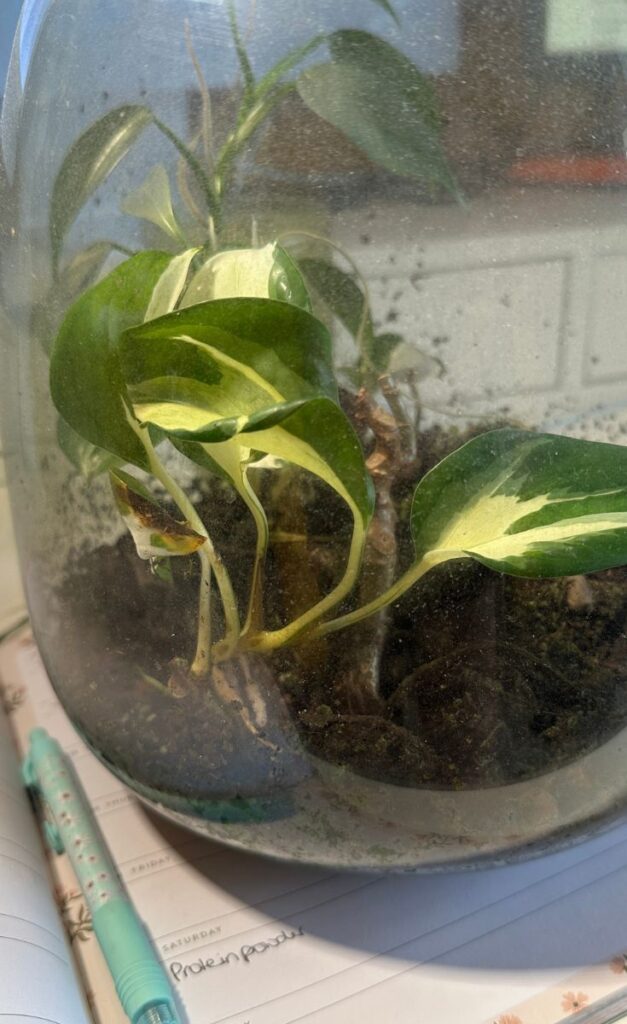
If you’re looking for a real, no-gimmick way to boost a struggling plant, a clear plastic box next to a bright window is a lil trick from me to you.
I may or may not have an old aquarium full of Begonia because it’s literally the only way I can get them to grow.
Signs Your Pothos Needs More Humidity
- Brown, crispy leaf edges (particularly on newer leaves)
- Leaves that look slightly dull or papery rather than glossy
- Slower growth than expected despite good light and watering
Worth noting: these symptoms overlap with other issues — underwatering and draughts can produce similar results. Rule those out before assuming humidity is the problem.
Why Are My Pothos Leaves Curling?
The Bottom Line On Pothos Humidity
Pothos aren’t high-maintenance about humidity.
They’ll grow well in normal household conditions.
Extra humidity can improve leaf quality and bump up growth speed, but it’s not a substitute for getting the basics right — light and watering will always have more impact.
If you want to increase humidity, get a humidifier or try a clear plastic enclosure. Put down the spray bottle. It’s doing nothing for your plant, and it might eventually cause issues.
Your Pothos is a tropical plant that has survived decades of being kept in offices and forgotten about. It does not need to be misted. It needs light, water when the soil is dry, and the occasional acknowledgement that it exists.
FAQ
What humidity do Pothos need?
Pothos grow well at humidity levels of around 40% and above — which is typical of most homes. They’ll tolerate lower levels, though leaves may develop brown edges. Higher humidity (50–70%) can improve leaf lushness and growth speed.
Does misting help Pothos?
No, not in any meaningful way. Misting raises the humidity around your plant for a minute or two before evaporating. It won’t raise ambient humidity, and wet leaves left to sit in still air can occasionally cause bacterial or fungal issues. Misting occasionally to remove dust is fine; misting as a humidity strategy is a waste of time.
What is the best way to increase humidity for Pothos?
A cool mist humidifier is the most effective method. Alternatively, placing your Pothos inside a clear plastic box or glass terrarium near a bright window can significantly raise the local humidity and dramatically improve growth.
Can too much humidity hurt a Pothos?
High humidity isn’t directly harmful to Pothos. The risk is indirect: in cold or low-light conditions, high humidity slows soil drying time, which can increase the risk of root rot. Make sure your plant has good light and warmth alongside higher humidity.
Do pebble trays increase humidity for Pothos?
The effect is too minimal to be meaningful. Pebble trays won’t harm your plant, but they won’t genuinely raise the ambient humidity either.