Yes, and they LOVE it.
Warm water, ambient humidity, the odd bit of fish poo — what’s not to love (for a plant)?
Do they prefer it to being grown in soil? Nah, it’s just different, like growing Pothos in LECA.
How It Works
Pothos grown in an aquarium are doing the same thing as Pothos grown in water: the roots hang down into the tank while the foliage sits above the waterline.
The plant absorbs water and *some* nutrients directly through its roots, develops water roots over time, and generally gets on with life.
What an aquarium offers over a plain vase of water is a consistently warm temperature, higher ambient humidity, and pretty consistent humidity. It’s a good environment for them.
Does Aquarium Water Actually Benefit Pothos?
The houseplant corner of the internet has got slightly carried away with this one.
You’ll see claims that fish tank water is some kind of superfood for plants — and while it’s true that fish waste contains nitrogen and other nutrients, any decent aquarium will be running a filter that removes the vast majority of that.
It’s really the warmth and that consistency that the Pothos digs.
Warm, clean, oxygenated water and the occasional bit of fish poop is a perfectly nice environment for a Pothos root system. It’s not a magic growth formula. Your fish’s contribution to your plant’s nutrition is appreciated but probably shouldn’t be its primary selling point.
My Own Private Aquarium Pothos
I currently have a Pothos growing in a fish tank. In the spirit of full transparency: it has thrips, and the leaves look terrible.
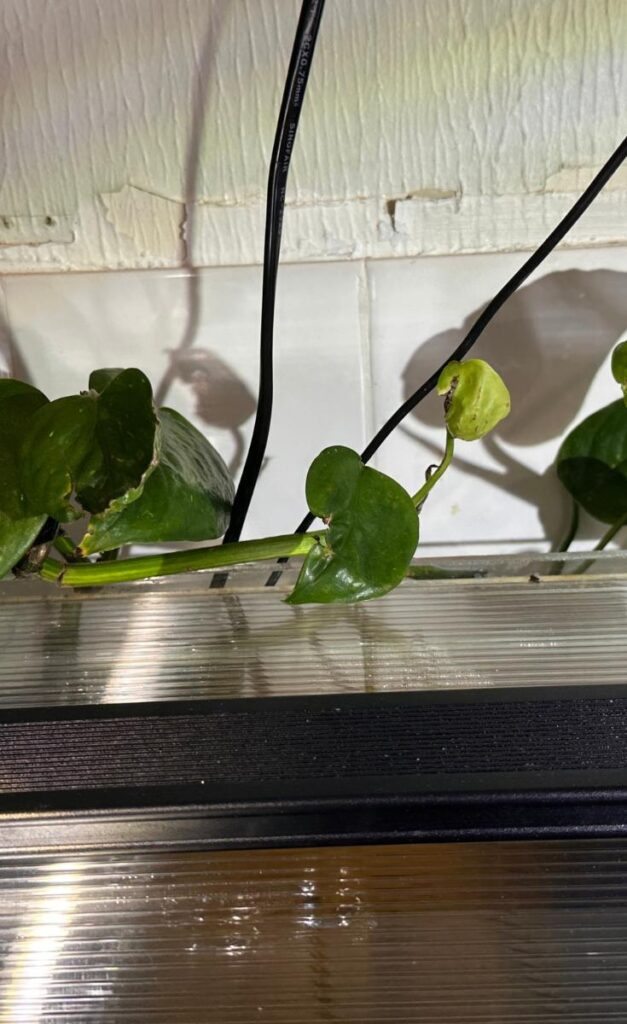
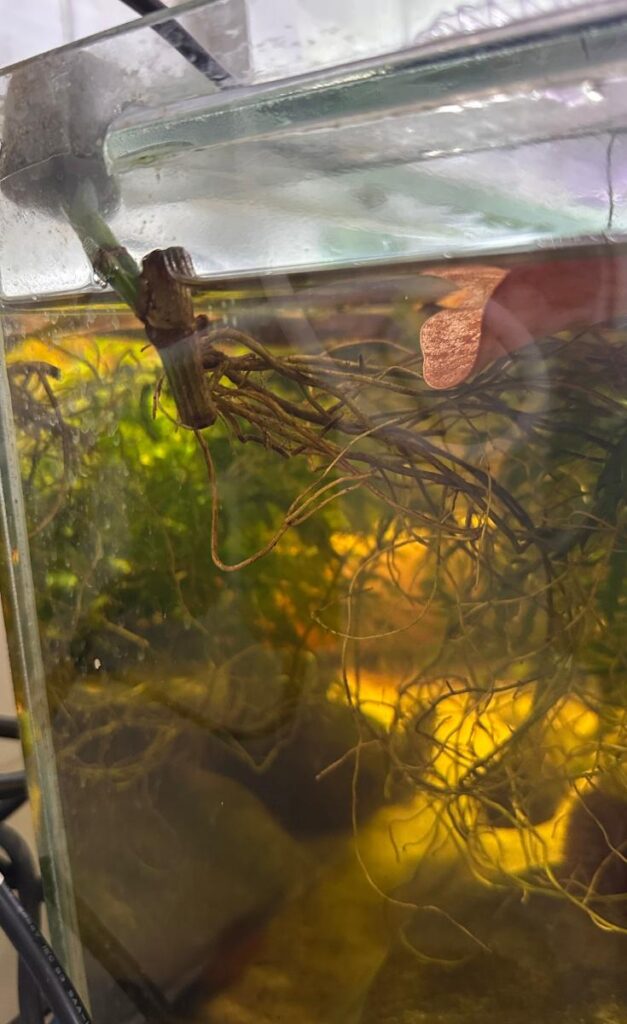
The roots, however, are spectacular. Long, healthy, clearly very happy in there.
It’s not their fault I never go in the fish room (it’s my boyfriend’s tank and Pothos).
Will The Fish Eat The Roots?
Some of them, yes. Goldfish in particular will absolutely help themselves to Pothos roots given the opportunity — they’re not fussy eaters and dangling roots are basically an invitation.
If you keep goldfish and want to add a Pothos, you’ll need to keep the roots out of reach or accept that your fish are going to snack on them.
This tank is full of armoured catfish (callichthys, in case anyone is interested) and eels. They much prefer worms to roots.
What About Lighting?
Your Pothos will need adequate light for the foliage above the waterline — and aquarium hood lights generally aren’t designed with that in mind. They’re optimised for what’s happening inside the tank, not above it.
If your tank is already in a bright spot, you may be fine. If it’s in a darker corner with only the hood light available, you’ll likely need a supplementary grow light for the plant. A Pothos that can’t photosynthesise properly won’t thrive regardless of how good the root environment is.
Or it might attempt to grow downwards, leading us neatly onto…
Can Pothos Grow Fully Submerged?
No. The foliage needs to stay above the waterline. What goes in the water is the roots — the plant itself sits at the rim of the tank or above it, trailing roots down into the water below. It’s the same principle as growing in a vase, just with fish in it.
Submerged leaves will rot. If you want aquatic plants you need, er, aquatic plants.
Does It Help Filter The Water?
A bit. Pothos roots do absorb some nitrates and other compounds from the water, which is genuinely useful. You’ll see this referred to as “natural filtration” in aquarium circles. It’s a real effect — just not a replacement for an actual filter. Think of it as a small bonus rather than a system.
The Best Pothos Trick For Aquarium Owners: Rooting Cuttings
Even if you don’t want a permanent Pothos installation on your tank, aquarium water is exceptional for rooting cuttings. The combination of warmth and oxygenated water gets nodes going much faster than a cold glass of tap water on a windowsill.
The trick is keeping the leaves out of the water while the nodes do their thing.
Float your cuttings in slices of pool noodle — poke the stem through the hole and the leaves will stop if from falling through.
Staking And Training
One practical limitation of aquarium growing is the same one that comes up with water growing generally: staking is awkward. You can’t just shove a moss pole in a fish tank.
Many aquarists solve this by adding frames or trellises around the outside of the tank for plants to climb up. If you’re setting up a planted tank display, it’s worth thinking about this from the start rather than trying to retrofit something later.
FAQ
Can pothos roots go in a fish tank?
Yes. Pothos grow well with their roots in aquarium water while the foliage sits above the waterline. They’ll develop water roots and absorb nutrients from the tank.
Will fish eat pothos roots?
Some will. Goldfish are particularly likely to nibble at roots — if you keep them, either protect the roots or expect some snacking. Most tropical fish will leave them alone.
Does pothos clean aquarium water?
Slightly — the roots absorb some nitrates and other compounds. It’s a useful bonus but not a replacement for a proper filter.
Can pothos grow fully underwater?
No. The roots go in the water, the foliage stays above it. Fully submerging the leaves will kill them.
Is aquarium water good for pothos?
It’s a decent environment — warm, oxygenated, with some dissolved nutrients from fish waste. The benefits are sometimes overstated online, but it’s genuinely a good place for roots to be.
Can I root pothos cuttings in my fish tank?
Yes, and it works very well. Float the cuttings in slices of pool noodle to keep the leaves above the waterline while the nodes root in the warm water below.