Repotting is one of those plant care tasks that gets massively overhyped.
Roots poking out the bottom?
Repot immediately.
Bought a new plant?
Repot it.
Plant looking a bit sad?
Maybe a repot would help.
Repotting is neither the saviour nor that devil that it’s reported to be. It’s just a thing that you are gonna have to do on occasation.
When Does A Pothos Actually Need Repotting?
Ok, take your plant out of the pot. Look at the root system. Look at the soil.
Are there more roots than soil?
If yes, maybe a repot is in order.
(Or, and don’t tell ANYONE I told you this, but you could also just give the roots a lil snip snip.
No one would know.
If the root ball still has visible soil, if the roots are filling the pot but there’s still growing medium around them, if the plant is growing well and the pot doesn’t feel like it’s about to crack — leave it alone.
The Roots-Out-The-Bottom Myth
This one is everywhere, so let’s deal with it directly: roots growing out of the bottom of a pot does not mean your Pothos needs repotting.
Roots grow downward because that’s where the water is. If you bottom water — or even if you just water normally and the excess drains out — the roots will follow the moisture and eventually find the drainage holes. That’s not a sign of a rootbound plant. That’s a plant doing exactly what roots are supposed to do.
You can just tuck those roots back in, or trim them if they’re getting unwieldy.
Either is fine.
The sign that actually matters is what’s happening inside the pot. Slide the plant out and have a look. More roots than soil? Time to repot. Mostly soil with some roots? Put it back and leave it alone.
Does Repotting Help A Struggling Plant?
Almost never. This is one of the most common mistakes in houseplant care — reaching for repotting as a solution when a plant looks unhappy.
Bear in mind that repotting (or something like it) is not something that would EVER happen to a plant in wild unless something really awful, like a flood or an earthquake, was happening.
If your Pothos is yellowing, drooping, or generally looking sorry for itself, the cause is almost certainly light, watering, pests, or temperature.
Repotting a stressed plant adds stress on top of stress. It doesn’t fix the underlying problem and can make things worse.
Sort out what’s actually wrong first. Repot once the plant is healthy, if it needs it.
I’ve repotted a Pothos that didn’t strictly need it — it was fine.
Healthy plants handle repotting well. But it wasn’t necessary, and it didn’t improve anything. If in doubt, leave it.
Do You Need To Repot If There Are Pests?
No. The instinct to “clean out” the pot when dealing with pests makes sense, but most houseplant pests live on the plant itself — the foliage, the stems, the undersides of leaves — not in the soil. Repotting won’t evict them, and the disruption is an added stressor the plant doesn’t need.
Treat the pest problem directly. Repotting is not part of that treatment.
if fungus gnats are your issue, a soil change will rarely help. You need to dry out the top of the soil.
Can You Repot In Winter?
Yes. The “only repot in spring” advice gets repeated a lot, but there’s no real reason to avoid repotting in winter if the plant genuinely needs it.
A healthy Pothos will handle it fine year-round.
But also, if your plant is growing slowing in due to the shorter hours of daylight, it is probably perfectly happy to wait until spring for the repot,
How To Choose The Right Pot Size
Confession time: I don’t really know how plant sizes work. The common advice is ‘go one pot size bigger’ as if there are standardised pot sizes.
Go a bit bigger. The worse that will happen is that go too big and have to water less frequently for a bit.
Overwaterers beware: A pot that’s too large holds far more soil than the roots can work through, which means the soil stays wet for much longer than it should.
The plant ends up effectively overwatered not because you watered too much, but because the pot is doing the damage for you.
Underwaterers: I would never tell you to use way too big of a pot size so you could water less often. This is not a exact science and can easily go wrong (I do however do it all the time, and as long as you use something super chunky in your soil like orchid bark, you’ll be grand).
How To Actually Repot A Pothos
I learnt this method from Monty Don, so you know it’s the correct way to repot a Pothos:
Fill the new pot with fresh soil up to the point where, if you set the old pot inside the new one, the rims of both pots are level. Then press the old pot gently into the soil to create a mould of exactly the right shape and depth. Remove the old pot.
Now slide your Pothos out of its current pot — root ball, soil, and all — and lower the whole thing into the gap you’ve just made. Fill around the sides with fresh soil and firm it down gently.
I have drawn you a diagram:
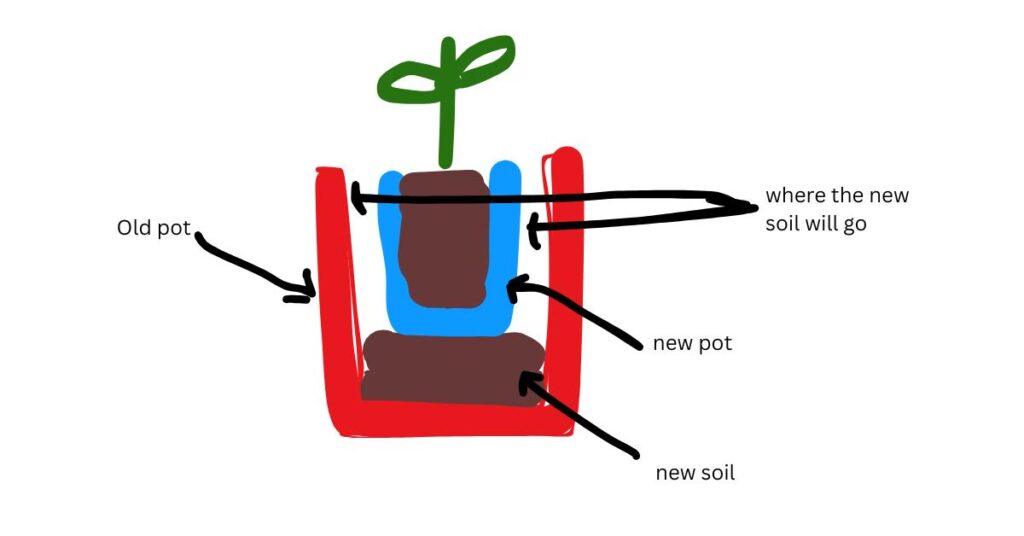
Obviously everything is now crystal clear.
Water thoroughly after repotting to help the soil settle around the roots, and then treat the plant as normal.
FAQ
When should I repot my Pothos?
When you remove the plant from its pot and can see more roots than soil. That’s the one reliable sign. Don’t repot on a schedule or based on how long the plant has been in its pot.
Do roots growing out the bottom mean I need to repot?
No. Roots grow downward toward water and will find drainage holes naturally — this is normal behaviour, not a distress signal. Slide the plant out and check whether roots are overwhelming the soil inside. That’s the test that matters.
How much bigger should the new pot be?
One size up — around 2 inches larger in diameter. A pot that’s too large holds more moisture than the roots can use, which leads to waterlogging even if you’re not overwatering.
Should I repot a sick Pothos?
No. Repotting stresses a plant. If your Pothos is struggling, find and fix the actual cause first — usually light, watering, or pests. Repot once it’s healthy and if it actually needs it.
Can I repot Pothos in winter?
Yes. There’s no rule against it. Growth is slower in winter so the plant will take a bit longer to settle in, but a healthy Pothos will handle repotting fine at any time of year.
Do I need to repot if my Pothos has pests?
No. Most houseplant pests live on the plant, not in the soil. Repotting won’t solve a pest problem — treat the pests directly and skip the unnecessary disruption.
Do I need to untangle or trim the roots when repotting?
No. Leave the root ball exactly as it is. The less you interfere with the roots, the less stress for the plant.
Do Pothos like being repotted?
They don’t care. They probably appreciate the fresh nutrients in the soil but dislike the upheaval. I assume they like being repotted as much as we like moving house.
Do Pothos like big or small pots?
They’re not particularly susceptible to root rot so they’re not fussed. I wouldn’t recommend going more than a bit bigger than the root ball.